


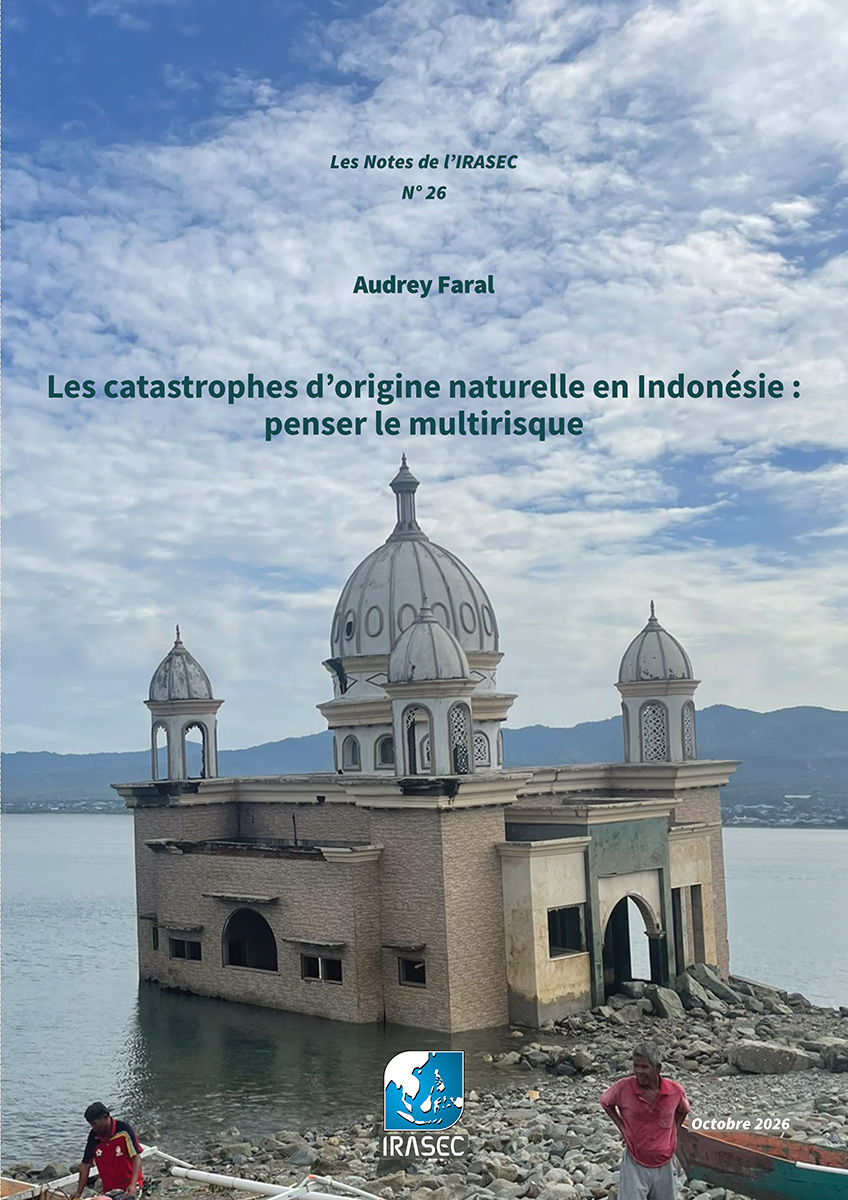
n°26 - Les catastrophes d’origine naturelle en Indonésie : penser le multirisque
 Audrey FARAL
IRASEC, Bangkok
October 2026, 32 p.
 Text in french
The 2011 Tohoku disaster (Japan) and the 2018 Palu disaster (Indonesia) have highlighted the importance of considering interactions between hazards, as well as their consequences for increasingly exposed populations and rapidly urbanizing territories. These events have contributed to the emergence of a new paradigm in risk assessment, based on a multi-hazard approach that moves beyond the isolated analysis of individual natural hazards to better characterize their interactions and combined effects.
This article provides an overview of this evolving paradigm in hazard and risk assessment, focusing on Indonesia, a territory particularly exposed to a wide range of natural hazards. An analysis of disasters recorded across the archipelago since the early twentieth century highlights a marked increase in their frequency since the 1970s, as well as a gradual evolution in disaster risk management policies, from an approach primarily focused on emergency response towards consideration of the entire disaster management cycle. However, risk management remains largely structured around hazards considered separately, despite their potential interactions.
This situation is further compounded by the limited knowledge of the history of disasters in Indonesia, with many past events remaining poorly documented, thereby limiting our understanding of the temporal variability of hazards and their interactions. Integrating these past events is therefore essential to identify multi-hazard configurations that may recur and for better assessing future risks. This article consequently highlights the value of an interdisciplinary approach combining geohistorical and geoscientific methods to investigate past events. Confronting historical archives with environmental data (e.g., geomorphological and stratigraphic observations, geochronological and geochemical data) makes it possible to reconstruct past events, characterize their chronology and interactions between hazards, and assess their impacts on societies. This approach has notably been applied to the 1257 Samalas eruption and the 22 November 1815 disaster in Bali. Studying historical disasters thus provides valuable insights into hazard interactions and can contribute to improving disaster risk management and reduction in Indonesia.
Read the Discussion Paper :

Audrey Faral holds a Ph.D. in physical geography and is a faculty member and researcher at Paris 1 Panthéon-Sorbonne University, affiliated with the Laboratory of Physical Geography in Thiais (CNRS, UMR 8591). As a geomorphologist, her research focuses on natural hazards and disasters (earthquakes, volcanic eruptions, landslides, and tsunamis) and their environmental and societal impacts, primarily in volcanic and/or island environments, particularly in Indonesia. Audrey Faral employs a geomorphological, stratigraphic, and geohistorical approach to study past environments and understand present-day dynamics, focusing in particular on the interactions between natural processes and societies.


