


n°25 - The Rise of Pet Culture in Southeast Asia
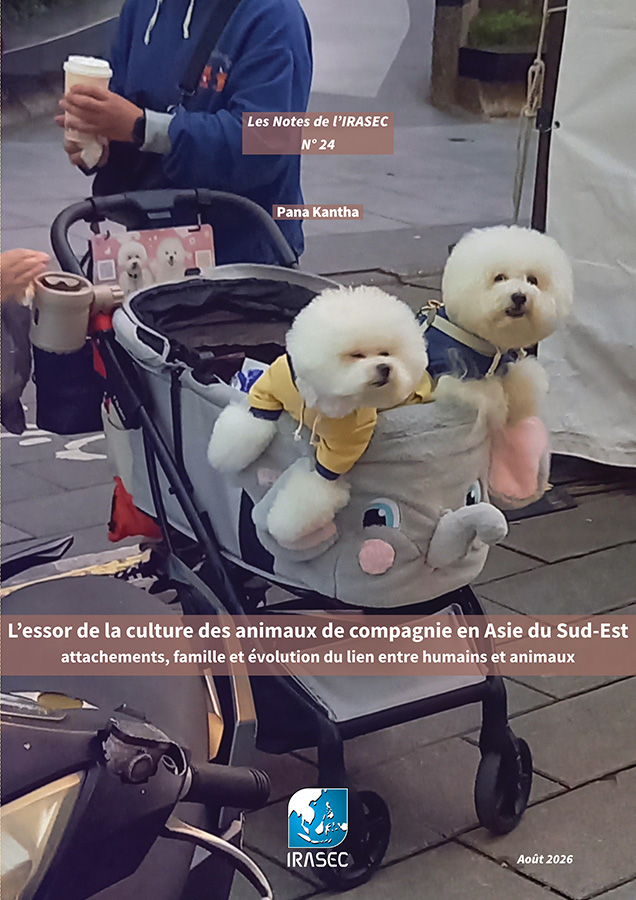 Pana KANTHA
IRASEC, Bangkok
August 2026, 19 p.
 Text in French
The recent and rapid adoption of pet culture in Southeast Asia is not simply a matter of the spread of the Western model, but rather a process of appropriation and reconfiguration shaped by local social structures and new lifestyles. This article analyzes this transformation through the concept of “multiple modernities,” showing how pet culture fits into societies characterized by the persistence of familism, despite profound demographic, economic, and urban changes.
In these contexts, pets become a new form of emotional investment, care, and responsibility, integrated into enduring family narratives rather than a purely individualistic logic. Their adoption, however, reveals the emergence of competing “moral economies,” pitting different conceptions of the legitimate family, the allocation of economic resources, and the place of animals in shared spaces against one another. These tensions are evident in urban policies, condominium regulations, and public debates, but they also foster new institutional adaptations : specialized infrastructure, professional services, and regulatory frameworks.
Far from being a linear process of Westernization, pet culture thus reveals the ability of Southeast Asian societies to transform globalized practices according to their own historical trajectories, producing unique forms of modernity in which the boundaries of family and care are gradually being redefined.
Read the Discussion Paper :

Pana KANTHA is an independant researcher. He holds an MA in Sociology and Anthropology from Chiang Mai University, with a thesis on pet culture in Thai society, which this article builds on and extends regionally. Past research has examined human-animal relationships more broadly, including the cross-border cattle trade across the Mekong subregion, and colonial-era conceptions of nature introduced through Christian missionary religion, and their lasting influence on Thai society. Current work focuses on the power relations and moral economy of Thai elephant tourism, within the broader field of conservation politics.


