


Vietnam’s growth model and its development ambitions
Conference
 9 October 2026, from 8:30am to 10:30am (UTC+7)
CCIFV office, 40 Hai Ba Trung, Hanoi, Vietnam
🇫🇷 Conference in French
Jean-Philippe EGLINGER (Inalco/ Viet Phap Strategies), associate research fellows at IRASEC, delivered a lecture analyzing a turning point in Vietnam’s development model—a model that, since the 1986 Đổi Mới reforms, has been built on economic openness, integration into global value chains, and an influx of foreign direct investment (FDI). While this model has yielded remarkable performance, it is now revealing its limitations : low domestic value-added, insufficient productivity gains, weak R&D, and difficulty in fostering a network of Vietnamese enterprises capable of moving up the value chain. Achieving the ambition of joining the ranks of high-income countries by 2045 will require a “second Đổi Mới”—one that is institutional rather than primarily economic. This would entail better coordination between the state, businesses, universities, and research institutions ; greater institutional autonomy ; a qualitative shift in the nature of FDI ; and the development of a robust national innovation ecosystem.
The discussion was moderated by Rémi NGUYEN, Vice-President of the CCIFV and an associate researcher at IRASEC.
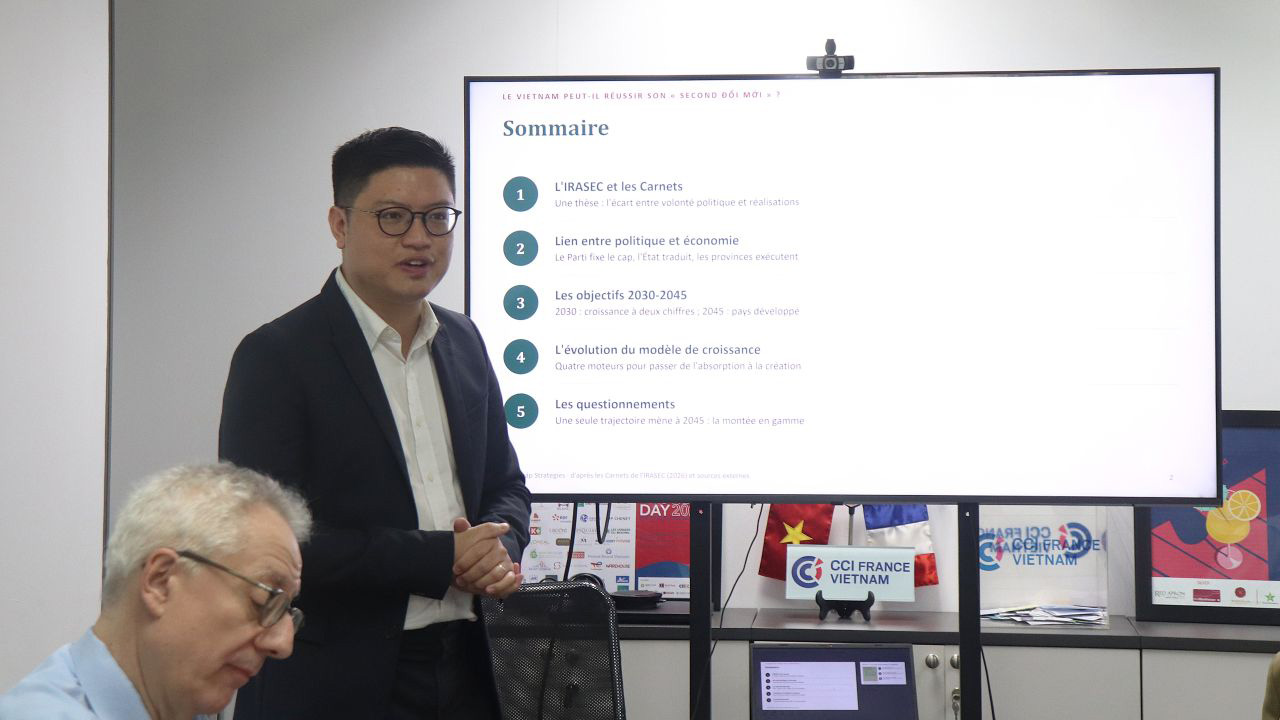

Vietnam has set two major targets : achieving annual growth of at least 10% and a GDP per capita of approximately USD 8,500 by 2030, followed by reaching high-income country status by 2045. The World Bank’s reclassification of Vietnam as an upper-middle-income country last July marked an important milestone towards these ambitions.
Three key takeaways emerged from the discussion :
- Understanding institutions to understand the economy. Strategic directions are established through Politburo resolutions and translated into laws and action programmes. Resolutions 57 (science, technology, innovation and digital transformation) and 68 (private sector development) highlight the reforms and priority sectors that will shape Vietnam’s future.
- Shifting to a new growth model. Growth driven by capital accumulation, foreign investment and a competitive workforce is reaching its limits. Future growth will increasingly depend on productivity gains through innovation, R&D, skills development and administrative efficiency. Resolution 57 sets a target of allocating 2% of GDP to R&D by 2030.
- Addressing the challenges ahead. R&D spending remains below 1% of GDP, while domestic private enterprises are still predominantly small businesses. Ultimately, the success of Vietnam’s ambitions will depend on the effective implementation of reforms.


