Accueil > Français > Ressources

The Indo-Pacific from Southeast Asian Perspectives / Panel discussion part2

Watch the video
Session 3 / The Indo-Pacific from Southeast Asian Perspectives : Centrality and Multilateralism in Uncertain Times
Chair : Prof. Suthiphand CHIRATHIVAT, Chulalongkorn University (Bangkok)
The Indo-Pacific considered as a maritime “super-region” acknowledge the fact that the Indian Ocean has replaced the Atlantic as the globe’s busiest and most strategically significant trade corridor, whose geographical center in Southeast Asia. The “ASEAN Outlook on the Indo-Pacific” in 2019 (...)

Lire la suite...

Japan’s Approach to Free and Open Indo-Pacific / Maiko ICHIHARA

Japan’s Approach to Free and Open Indo-Pacific
Maiko ICHIHARA, Graduate School of Law, Hitotsubashi University, Japan, and visiting scholar at Carnegie Endowment for International Peace
This presentation looks at Japan’s approach to the Free and Open Indo-Pacific vision, and analyzes that Japan promotes liberal values with an incrementalist and pluralistic approach. Japan is uniquely positioned to operate in the diplomatic space between the value-laden approach of Western democracies and (...)

Lire la suite...

Europe Rediscovers the Indo-Pacific… Xi Jinping and Joe Biden / David CAMROUX

Europe Rediscovers the Indo-Pacific… Xi Jinping and Joe Biden
David CAMROUX, SciencesPo, Honorary Research Fellow, Center for International Studies (CERI), Paris
It was the German General K Haushofer, in his Geopolitik des Pazifischen Ozeans (1924) who created the denomination ‘Indo-Pacific’. A century later, in October 2020, the German Foreign Ministry framed its Asia policy guidelines as directed towards an Indo-Pacific region. As is often the case, it was its French counterpart which had (...)

Lire la suite...

Chinese Perspectives of the Indo-Pacific Concept and Major Power Relations / HOO Tiang Boon

Chinese Perspectives of the Indo-Pacific Concept and Major Power Relations
HOO Tiang Boon, RSIS, Singapore
In recent years there have been growing attention on, and increasing usage of, the term “Indo-Pacific” to characterize the political geography of the Asia-Pacific region. While the concept itself is not new and has multiple origins, it gained new levels of prominence when Washington began to evoke the parlance in its policy documents and rhetoric from around 2017. American employment (...)

Lire la suite...

India’s Approach to the Indo-Pacific / Shankari SUNDARARAMAN

India’s Approach to the Indo-Pacific : Assessing the Critical Shifts in the Post Covid 19 Period
Shankari SUNDARARAMAN, Centre for Indo-Pacific Studies (CIPS), Jawaharlal Nehru University (JNU), New Delhi
The regional balance in the Indo-Pacific has been seeing considerable shifts for nearly two decades with structural changes pushing regional geopolitics to the forefront. Even as the US China rivalry will remain the determining factor for the immediate future of the international order, (...)

Lire la suite...

Prospects for a multi-polarity in ASEAN / Thomas PARKS

Prospects for a multi-polarity in ASEAN
Dr. Thomas PARKS, Asia Foundation
The China-US strategic rivalry has galvanized interest in Southeast Asia in ways not seen since the Cold War. However, the rivalry also threatens to bifurcate the ASEAN group of nations should countries be forced into a strategic alignment with superpowers. ASEAN member states have been at the center of great power competition before, but the conditions today are much more conducive for the interests of the region’s (...)

Lire la suite...

Geopolitics in the Indo-Pacific : The Intersecting Interests of Other Major Powers / Panel discussion

Watch the video
Session 4 / Geopolitics in the Indo-Pacific : The Intersecting Interests of Other Major Powers
Chair : Dr. Claire, Thị Liên TRẦN, IRASEC/Univ de Paris
These last 15 years, other great powers have redefined their strategy in the region, replacing the concept of Asia-Pacific to the one of Indo-Pacific. Indeed, the region involves the intersecting interests of two other major powers - Japan and the United States - and significant middle players – Australia and South Korea as (...)

Lire la suite...

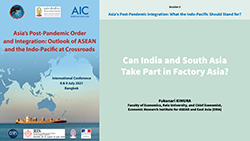
Can India and South Asia Take Part in Factory Asia ? / Fukunari KIMURA

Can India and South Asia Take Part in Factory Asia ?
Fukunari KIMURA, Faculty of Economics, Keio University, and Chief Economist, Economic Research Institute for ASEAN and East Asia (ERIA)
The economic context of Indo-Pacific has not well developed yet due to a currently thin economic relationship between ASEAN/East Asia and India/South Asia in the international division of labor. India and South Asia have not participated in the East Asian task-by-task division of labor centered by (...)

Lire la suite...

Asian integration : Post-pandemic realities / Mia MIKIC

Asian integration : Post-pandemic realities
Mia MIKIC, Advisor at Large, ARTNeT and Visiting Fellow, Institute for Euro-Asian Studies, Zagreb University
Before the global pandemic, there were several challenges to the Asian trade environment – globalization, weakened multilateral trade regime, diverse participation of Asian economies in the Factory of Asia and sharply increased uncertainty primarily due to trade tensions between the US and China. The pandemic-driven disruptions of supply (...)

Lire la suite...

Asia’s Post-Pandemic DisIntegration ? / Jayant MENON

Asia’s Post-Pandemic DisIntegration ? Dealing with Disruptive Technologies and Divergent Demographics Amid Pandemic Fallout
Jayant MENON, ISEAS – Yusof Ishak Institute
New variants of the coronavirus are producing the worst outbreaks in many countries in the Indo Pacific. Progress with vaccine rollouts has been uneven, further contributing to inequality of outcomes. The pandemic could have lasting effects by reinforcing nationalism, protectionism, and other trends that are already (...)

Lire la suite...

| 1 | ... | 18 | 19 | 20 | 21 | 22 | 23 | 24 | 25 | 26 | 27 |